July 4, 2026 ยท 250th Anniversary
An interactive look at the most famous sentence in American history, and the idea at its heart: the consent of the governed.
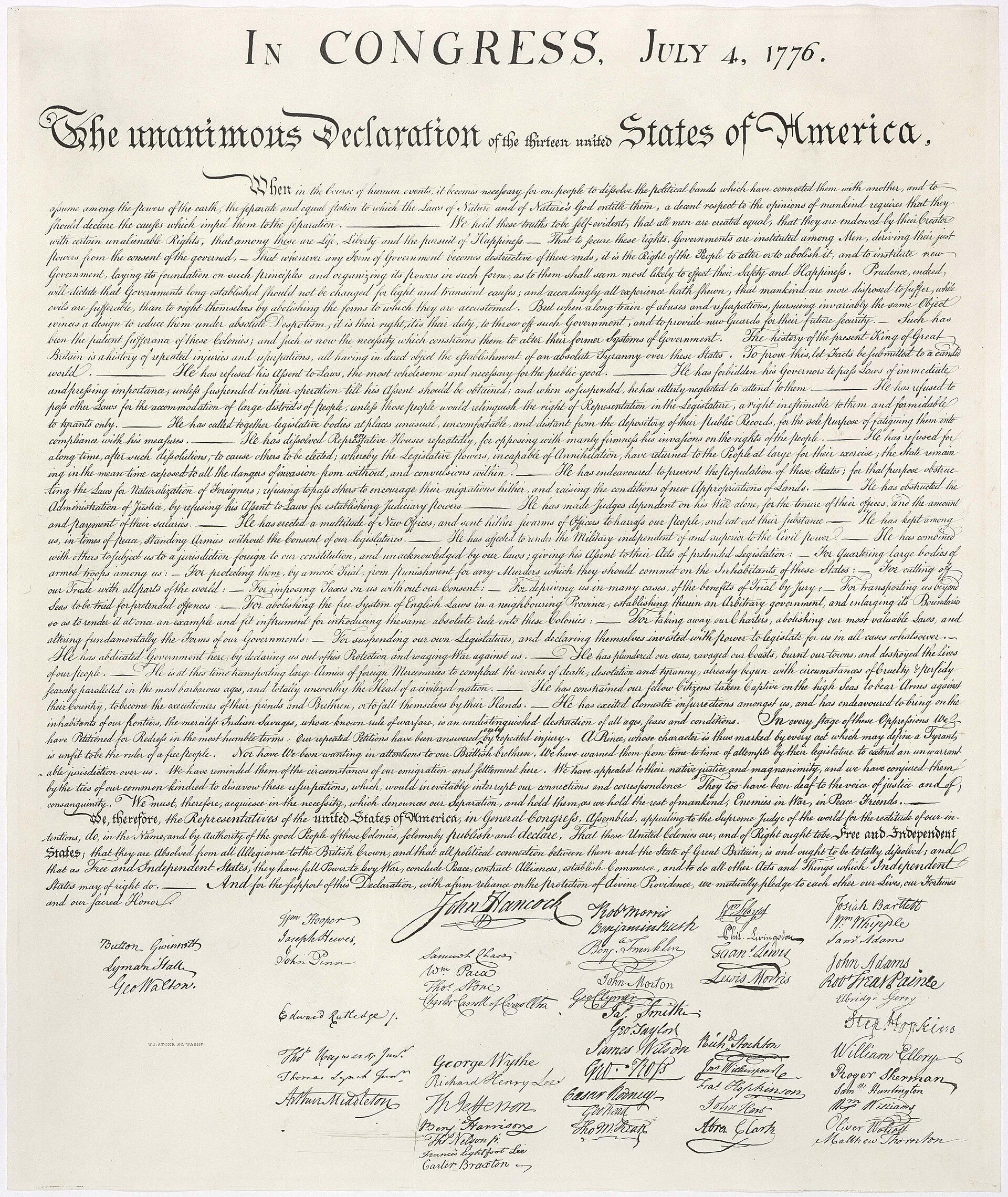
"We hold these truths to be self-evident, that all men are created equal, that they are endowed by their Creator with certain unalienable Rights, that among these are Life, Liberty and the pursuit of Happiness."
The Sentence, Annotated
Thomas Jefferson packed an entire theory of government into two sentences. Tap each highlighted phrase to see what it means, with special attention to where the people's power comes from.
The Core Idea
The Declaration says governments derive "their just powers from the consent of the governed." Everything on this site turns on one word: just. Here is what it means.
A government can hold raw power, the ability to make people obey through force, without holding any just power. "Just" means rightful, or legitimate: the moral authority to govern, not merely the muscle to compel.
Consent is what turns raw power into rightful authority. No consent, no just power, however many soldiers or dollars a regime commands. That is the whole claim of the sentence.
A regime can sit at high raw power but low just power when few consent. That is exactly the case the Declaration says justifies the people in altering or abolishing the government.
Two tools below make this concrete: the math of many shows why pooled consent can be trusted, and the Consent Engine lets you watch just power rise and fall as consent changes.
The Math of Many
If legitimate power comes from the people, a fair question follows: are the people any good at deciding? In 1785 the Marquis de Condorcet gave a reassuring answer. His Jury Theorem shows that when a group decides by majority and each member is even slightly more likely than not to be right, the group grows more reliable as it gets larger, approaching near-certainty. The same math runs in reverse: if each member is worse than a coin flip, bigger crowds get it more wrong. Consent works best when the governed are informed.
Put one yes-or-no question to a group. Each person decides independently and is correct with some probability p. The group's answer is whatever the majority picks.
If p is over 50%, the probability the majority is correct climbs toward 100% as the group grows. If p is under 50%, it falls toward 0%. More heads help only when the heads are better than a coin flip.
This is the quiet case for government by consent: the pooled judgment of many can beat the decree of one. It also explains why a free press, open debate, and education are not luxuries, they are what keep each citizen above that coin-flip line.
The theorem has a sharp edge. If each person is worse than a coin flip, say right only 40% of the time, majority rule does not cancel the error, it compounds it. Set the slider to 40% with a group of 11 and the majority lands on the right answer only about 25% of the time, worse than flipping a coin. The crowd becomes confidently, reliably wrong.
Why does adding people make it worse? A majority amplifies whatever tendency its members share. Above 50% that shared tendency points toward the truth, and pooling sharpens it toward certainty. Below 50% the shared tendency points away from the truth, and pooling sharpens the mistake instead. That is the failure mode behind mobs, propaganda, and manipulated elections, and it is why a free press, open debate, and education are not extras. They keep each citizen above the coin-flip line, the line that decides whether the consent of the governed is wisdom or folly.
The STEM
"Governments... deriving their just powers from the consent of the governed." This is a claim you can model. Below, a hundred citizens make up "the governed." Move the slider to change how many consent, and watch a government's just powers respond.
How is "just power" earned?
Contested
With a clear share of the governed consenting, the government holds real but partial authority.
The Pulse
Twenty questions drawn from across the whole site, including the historical grievances. Pick a wrong answer and you will see exactly which part is wrong, and why. No peeking.
You will get your score at the end, plus the option to add your name to the leaderboard.
Your pulse
Registration is optional. Add your name only if you want your score posted.
The Board
| # | Name | School / State | Score |
|---|---|---|---|
| Loading the board... | |||